Hidden between the Colosseum, Trajan’s Market and Rome’s busiest streets lies a neighbourhood that feels surprisingly different from the rest of the city.
With ancient history beneath its streets and a village atmosphere above them, Monti offers one of the most enjoyable ways to experience Rome beyond the major landmarks.
Understanding Monti
Many visitors walk through Monti without ever realising it.
They visit the Colosseum, explore the Roman Forum and continue towards the historic centre, unaware that one of Rome’s most fascinating neighbourhoods is only a few minutes away.
Monti is Rome’s oldest official district, known as Rione I Monti. Its name, meaning “mountains,” originally referred to three of Rome’s famous hills: the Esquiline, the Viminal and part of the Quirinal.
Today, Monti is known for its artisan shops, independent boutiques, wine bars and creative atmosphere. Yet behind its fashionable appearance lies a history stretching back more than two thousand years.
To understand Monti, you first need to understand what stood here before.
Ancient Rome’s Most Lively Neighbourhood
When people think of Ancient Rome, they often imagine emperors, gladiators and magnificent temples.
But most Romans were not emperors.
They were merchants, craftsmen, traders, labourers, shopkeepers and families trying to earn a living.
Much of Monti formed part of an area known as the Suburra, one of the busiest and most densely populated districts of Ancient Rome.
While emperors and wealthy families occupied grand villas on nearby hills such as the Palatine, the Suburra was where much of everyday Roman life took place.
Its streets were filled with workshops, taverns, merchants, apartment buildings and residents from all walks of life. The area was famous throughout Rome for being lively, crowded and sometimes chaotic. Gambling houses, taverns and prostitution all contributed to its colourful reputation.
In many ways, the Suburra was the real Rome.
This was where ordinary people lived, worked, traded, socialised and built their lives.
How To Arrive
One of Monti’s greatest strengths is its location.
You can walk here from the Colosseum in less than ten minutes, from Termini Station in around fifteen minutes, or easily reach it from many parts of the historic centre.
One reason Monti feels surprisingly peaceful is that two of Rome’s busiest roads, Via Nazionale and Via Cavour, run along its edges. Together they absorb much of the city’s traffic, leaving many of Monti’s internal streets remarkably calm.
Step away from the main roads and you’ll quickly find yourself wandering through cobbled lanes, pastel-coloured buildings, climbing ivy and hidden corners that feel far removed from the bustle of central Rome.
A Village Hidden In The Heart Of Rome
One of the most surprising things about Monti is how quickly it feels different from the rest of central Rome.
Only a few minutes separate the neighbourhood from the crowds of the Colosseum, yet the atmosphere changes almost immediately.
Start on Via dei Serpenti, one of Monti’s most famous streets. Here you’ll find cafes, wine bars, boutiques and occasional views towards the Colosseum. Continue towards Via Leonina and Via del Boschetto, where independent shops, artisan workshops and ivy-covered buildings give the neighbourhood much of its charm.
Further north, Via Urbana and Via Panisperna reveal a quieter side of Monti, where local cafes, small businesses and residential streets create an atmosphere that feels surprisingly village-like for the centre of a capital city.
Ancient Rome Beneath Your Feet
Monti sits among some of the most important remains of Ancient Rome.
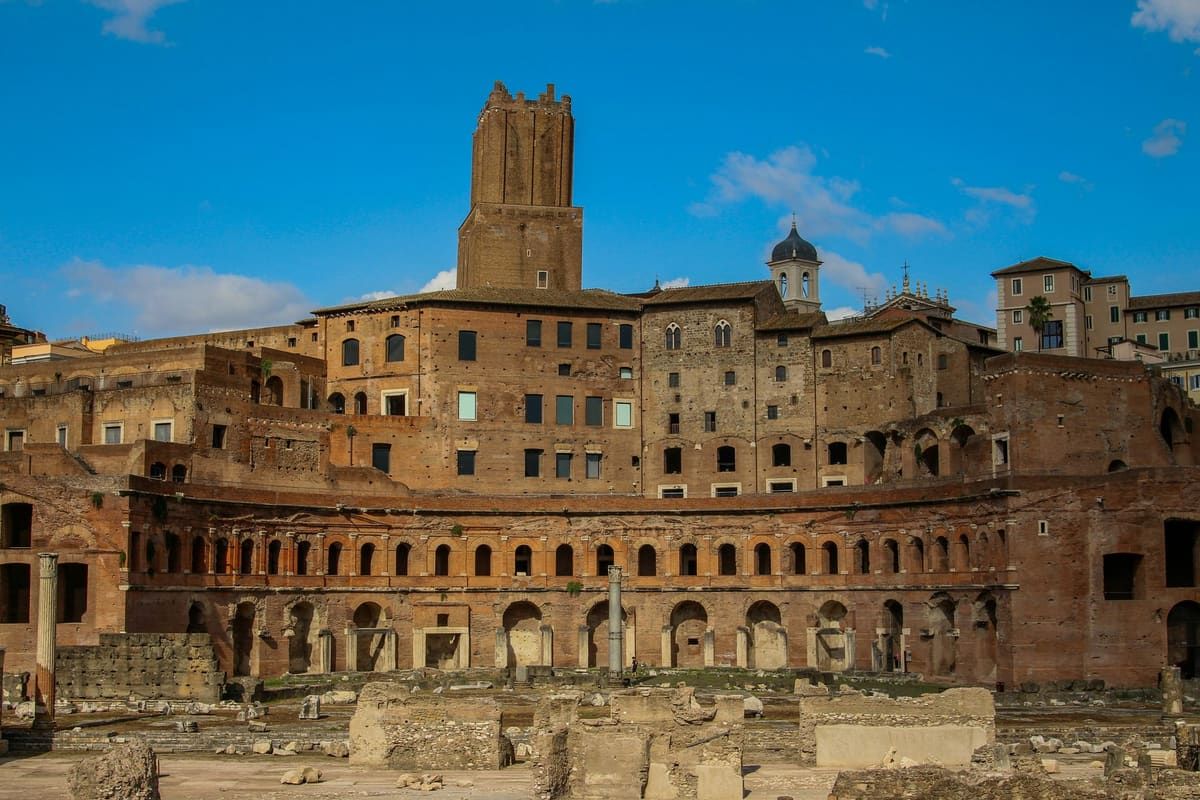
One of Monti’s most fascinating landmarks is Trajan’s Market, located beside Via dei Fori Imperiali on the edge of the Imperial Fora. Built almost 2,000 years ago, it is often considered the world’s first shopping centre. The vast complex contained shops, offices and public spaces spread across several levels connected by streets, staircases and corridors.
While it was not a shopping centre in the modern sense, it served a similar purpose as a place where people worked, traded and carried out daily business. Today, visitors can explore its remarkably well-preserved remains, walk along ancient streets and enjoy impressive views over the Imperial Fora, often with far fewer crowds than nearby archaeological sites.
Nearby, the Imperial Fora formed the political and ceremonial heart of the Roman Empire, while Trajan’s Column still stands as one of the best-preserved monuments from the ancient world, telling the story of Emperor Trajan’s military victories through an extraordinary spiral carving that wraps around the column.
A short walk away lies the Domus Aurea, the enormous palace built by Emperor Nero after the Great Fire of Rome, and the Ludus Magnus, the largest gladiator training school in the city, where fighters prepared before entering the Colosseum.
Few neighbourhoods in Rome place so much history within such a small area.
Piazza Della Madonna Dei Monti
For many locals, Piazza della Madonna dei Monti is the true heart of the neighbourhood.
At its centre stands a sixteenth-century fountain that has served as a meeting place for generations. During the day, you’ll find residents sitting on its steps, students studying, artists sketching and locals taking a break between errands.
As evening approaches, people gather around the fountain with a drink in hand, conversations spill across the square and the piazza becomes one of the most enjoyable places in Rome to simply sit and watch daily life unfold.
If you only have time to experience one place in Monti, make it this square.
Monti Today
Today, Monti is one of Rome’s most loved neighbourhoods, attracting a mix of locals, artists, students and visitors looking for a quieter side of the city.
Its streets are lined with independent boutiques, artisan workshops, vintage shops, cafes and wine bars, particularly around Via del Boschetto, Via Leonina and Via Urbana.
As evening approaches, locals gather around Piazza della Madonna dei Monti, while nearby streets fill with people enjoying aperitivo and dinner.
In a city famous for its landmarks, Monti reminds us that some of Rome’s most memorable experiences are found not inside the monuments themselves, but in the neighbourhoods that have grown around them for centuries.